
219. Lions and Monsters (again again) Part 2.
(morning thinking)

Part II — The Dragon in the House
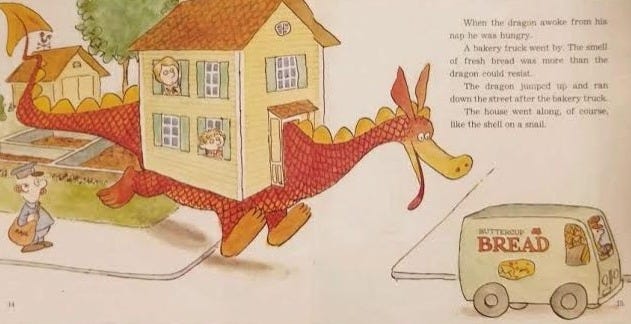
Last week I wrote about lions. The obvious problems humans have become remarkably good at solving. Disease. Famine. Distance. The great prowling threats that once stalked every human village. But when we defeat a lion, the terrain shifts. The solutions change the landscape. New, subtler problems begin to grow in the space we’ve cleared. This week I want to look at those slower consequences - the dragons that appear small, useful and rational… and keep growing.
Here be Dragons.
In the children’s book There’s No Such Thing as a Dragon by Jack Kent, a small dragon appears in young Billie Bixbee’s bedroom. His mother insists it’s not real. The more the dragon is denied, the larger it grows. Eventually it becomes so large that it lifts the entire house off its foundations. The dragon only begins to shrink back down to a friendly size when the mother finally acknowledges its existence. It’s not in the story but I imagine that the reality clicks into place around the point when she can’t open the gin cabinet door.
The simple story contains a valuable metaphor. Modern dragons, the monsters that threaten our species or environment, rarely announce themselves as threats. Plastic was a miracle. The smartphone was connection in the palm of the hand. Socials platforms dissolved geographic isolation. Optimisation culture promised efficiency and self-improvement.
None of them arrived breathing fire. They turned up in our lives small, useful, rational, then scaled to wondrous levels and kept growing.
And GROWING.
Have we built systems that scale dissatisfaction more efficiently than contentment?
Consumerism (not trade) is built on institutionalised inadequacy and depends on the premise that you’re incomplete. Completion can be bought, but you’d better hurry - ten other people like you already have wholeness in their baskets. Stocks are limited.

The attention economy thrives on agitation. Advertising thrives on comparison. Social media thrives on visibility. Growth thrives on aspiration, and aspiration easily mutates into insufficiency.
If enoughness became widespread, certain engines would stall.
This line of reasoning doesn’t require conspiracy thinking. It’s an existing system built on tangible incentives. We want desperately to make sense of the unnatural maladies of modernity. The wealthy corporate elite, corrupted by unimaginable wealth, want more money.
Infrastructural dissatisfaction stops feeling like architecture and starts feeling like personality. Anxiety becomes identity. Optimisation becomes virtue. Self becomes project and the growing dragon pushing against the walls begins to compromise the foundations of society.
I doubt it’s a question of whether the dragon is good or bad. The question is likely whether we are willing to see it at its true scale.
A little discontent sharpens us, drives innovative experimentation, progress, art but an economy of permanent discontent is exhausting. Depletes us. We become less human. More what? Mechanical? Maybe less analogue and messy, more digital and complex? There is a difference between personal tension and industrial amplification.
Could we try keeping a little human-sized friction?
Could we try to recognise when irrational behaviour is emerging from distorted conditions and then look for the rational middle ground?
Technology is changing us faster than our ability to notice how the new tools rearrange us.
I think we need to look directly at the dragon - with proportion rather than panic - and then rearrange the furniture accordingly.
The dragon isn’t good or bad.
But it’s in the house.
And it’s still GROWING.
Okay. Frivolity now yeah? Shake it off. Shall we sing? What would you like to sing? Maybe we do a dance. Or just blow a loud raspberry.
Thanks for reading. It’s a chunk of think that’s been rattling about in my head and I’m glad it’s out. I hope it’s not been an inconvenience for you. I appreciate you reading but you’re not my therapist.
Maybe you are a teensy bit.
I’m grateful.
Join in please with comments and tweaks. Where’s my thinking gone rubbish?
I promise to write something silly next. ACID Mouse or Leg Stains. That kind of thing. Hit them now if you need an antidote to this last post. Subscribe if you’d like more of either tone. There’s probably no pattern or process.
Like, share, restack. These are all really important although I don’t know I’d be comfortable digging into why. Humour me?
Thank you bye.
Paul. x.